
Pairing bonus
A fixed amount or percentage paid for every matched pair of left and right volume, e.g. 1:1 or 2:1 ratios.
A binary plan is an MLM compensation structure where every member has only two front-line positions, a left leg and a right leg, and earns a pairing bonus on the volume matched between them. MLM.ERP binary MLM software automates placement, spillover, carry-forward, pair capping and matching bonuses in real time, so admins never reconcile legs by hand.
Product companies that want simple team-building rules and are ready to manage weaker-leg balancing carefully.
A sponsor enrols a new member and chooses, or lets the system choose, the left or right leg.
If both front positions are filled, the new member spills over to the next open slot below.
Every purchase adds business volume (BV) up the tree to each upline’s left or right total.
The engine pairs left volume against right volume at each cut-off and pays the pairing bonus.
Unpaired volume on the stronger leg is carried forward, flushed or capped according to your rules.
Every income type below is configurable in MLM.ERP: rates, levels, caps and qualification rules.
A fixed amount or percentage paid for every matched pair of left and right volume, e.g. 1:1 or 2:1 ratios.
A percentage of the pairing income earned by personally sponsored members, often across two or three generations.
A one-time reward credited to the sponsor when a new member activates a package.
Unmatched points on the stronger leg roll into the next cycle instead of being lost, if you enable it.
Milestone rewards unlocked once cumulative paired volume crosses a configured threshold.
Suppose a member’s left leg holds 12 active members and the right leg holds 9, each carrying 100 points. With a 1:1 pairing rule, the engine matches 9 pairs and pays the configured pairing value on each one. The extra 300 points on the left leg are carried forward to the next cycle. If the daily cap is set at 8 pairs, only 8 are paid today and the remaining pair follows your flush or carry policy.
Illustrative figures only. Actual results depend on your plan configuration and genuine sales activity. No earnings are implied.
Configure income types, rates and levels, watch the network grow and approve payouts from the same dashboard. This is a real MLM.ERP screen.
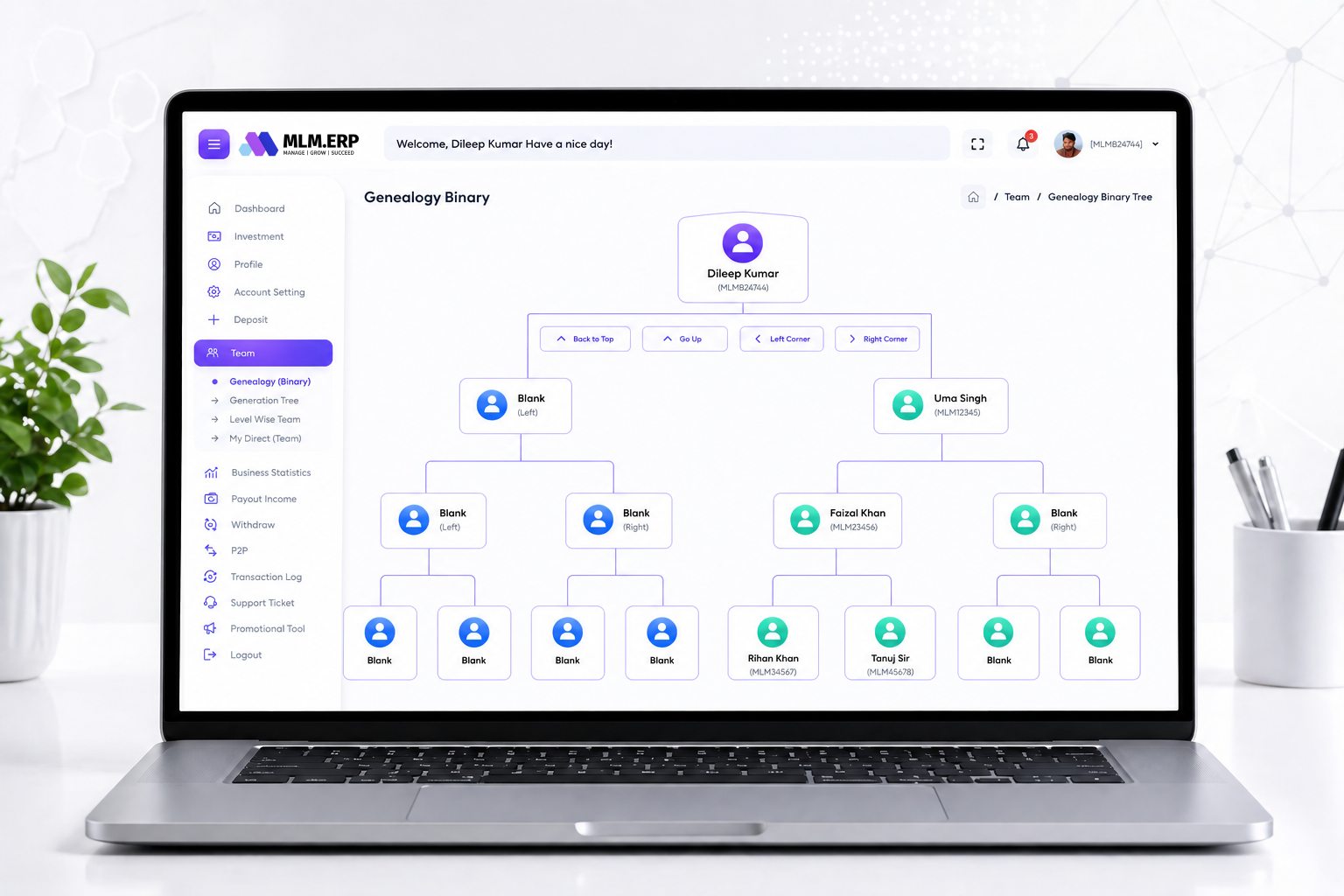
Drill into any member’s left and right legs, see pending volume and spot weak legs before they stall growth.
Set 1:1, 1:2 or 2:1 ratios, first-pair conditions and binary cut-off times from the admin panel without code.
Apply daily, weekly or package-based pair caps and choose whether excess volume flushes or carries forward.
Auto-place recruits in the extreme left, extreme right or weaker leg, or let sponsors choose manually.
Compare left and right business volume, carry-forward balances and paid pairs for any date range.
Members track pairs, wallet balance and new joins on white-label Android and iOS apps.
| Attribute | Binary Plan | Matrix Plan | Unilevel Plan |
|---|---|---|---|
| Structure | Two legs: left and right | Fixed width × depth grid | One unlimited front line |
| Payout basis | Matched (paired) leg volume | Level-wise volume in matrix | Monthly product volume |
| Main income | Pairing bonus | Level commission | Unilevel commission |
| Best for | Product companies that want simple team-building rules and are ready to manage weaker-leg balancing carefully. | Businesses that want a capped, predictable structure where spillover helps newer members fill their positions. | Consumer-product brands with regular repeat purchases, such as wellness, personal care or household goods. |
See every plan side by side in the full comparison table.
Can't find your answer? Our team can review your plan design in a free demo.
Ask a questionCommission is paid on matched volume. The software totals business volume on the left and right legs, pairs them using your ratio (for example 1:1), and pays a pairing bonus per matched pair. Any surplus on the stronger leg is carried forward or flushed, depending on the rules you configure in MLM.ERP.
Spillover happens when a sponsor recruits more people than their two front-line positions can hold. The extra members are placed lower in the tree, usually under a downline member. MLM.ERP lets you set automatic placement to the extreme left, extreme right or weaker leg, or allow manual placement by the sponsor.
Capping limits how many pairs or how much pairing income a member can earn in a cycle. Flush-out decides what happens to volume that is not paid: it can be cleared at the cut-off or carried forward. Both settings protect the company’s payout ratio and are fully configurable in the admin panel.
Yes. Many companies combine binary pairing on joining packages with a separate repurchase or unilevel bonus on monthly product orders. MLM.ERP supports hybrid plans, so repurchase BV can feed the binary tree, a level-based bonus, or both, with each income shown separately in the member’s wallet.
A fixed-width grid that fills itself – predictable depth, shared spillover, clear payouts.
Sales-ledSponsor without limits and earn on product volume across the levels your rank unlocks.
SustainableReward repeat product orders, not just sign-ups – income that follows real consumption.
Tell us about your products, plan and markets. A product specialist will show you the admin panel, member back office and mobile app configured the way you work, then send a written proposal.