
Level commission
A percentage of each downline member’s volume, set separately for every level of the matrix.
A matrix plan is an MLM compensation structure with a fixed width and depth, such as 3x9 or 5x7, where each member can hold only a set number of front-line positions and extra recruits spill into lower levels. MLM.ERP matrix MLM software handles automatic placement, level-wise commissions, matrix completion bonuses and re-entry rules from one configurable engine.
Businesses that want a capped, predictable structure where spillover helps newer members fill their positions.
Admin defines the matrix size, for example 3 wide and 7 levels deep.
New members fill the sponsor’s front line until all positions are taken.
Further recruits spill over into the next open slot using breadth-first or sponsor-first rules.
Each purchase or activation pays a configured percentage to uplines within the matrix depth.
When a matrix is completely filled, a completion bonus or re-entry can be triggered.
Every income type below is configurable in MLM.ERP: rates, levels, caps and qualification rules.
A percentage of each downline member’s volume, set separately for every level of the matrix.
A one-time reward paid when all positions in a member’s matrix are filled.
A share of the level income earned by direct referrals, if enabled.
An immediate credit to the person who personally introduced the new member.
In a 3x3 matrix, a member can have 3 people on level 1, 9 on level 2 and 27 on level 3, a total of 39 positions. If level percentages are set at 5%, 3% and 2% of each member’s 100-point purchase, a fully filled matrix produces 15 points from level 1, 27 points from level 2 and 54 points from level 3, or 96 points in total, before any completion bonus.
Illustrative figures only. Actual results depend on your plan configuration and genuine sales activity. No earnings are implied.
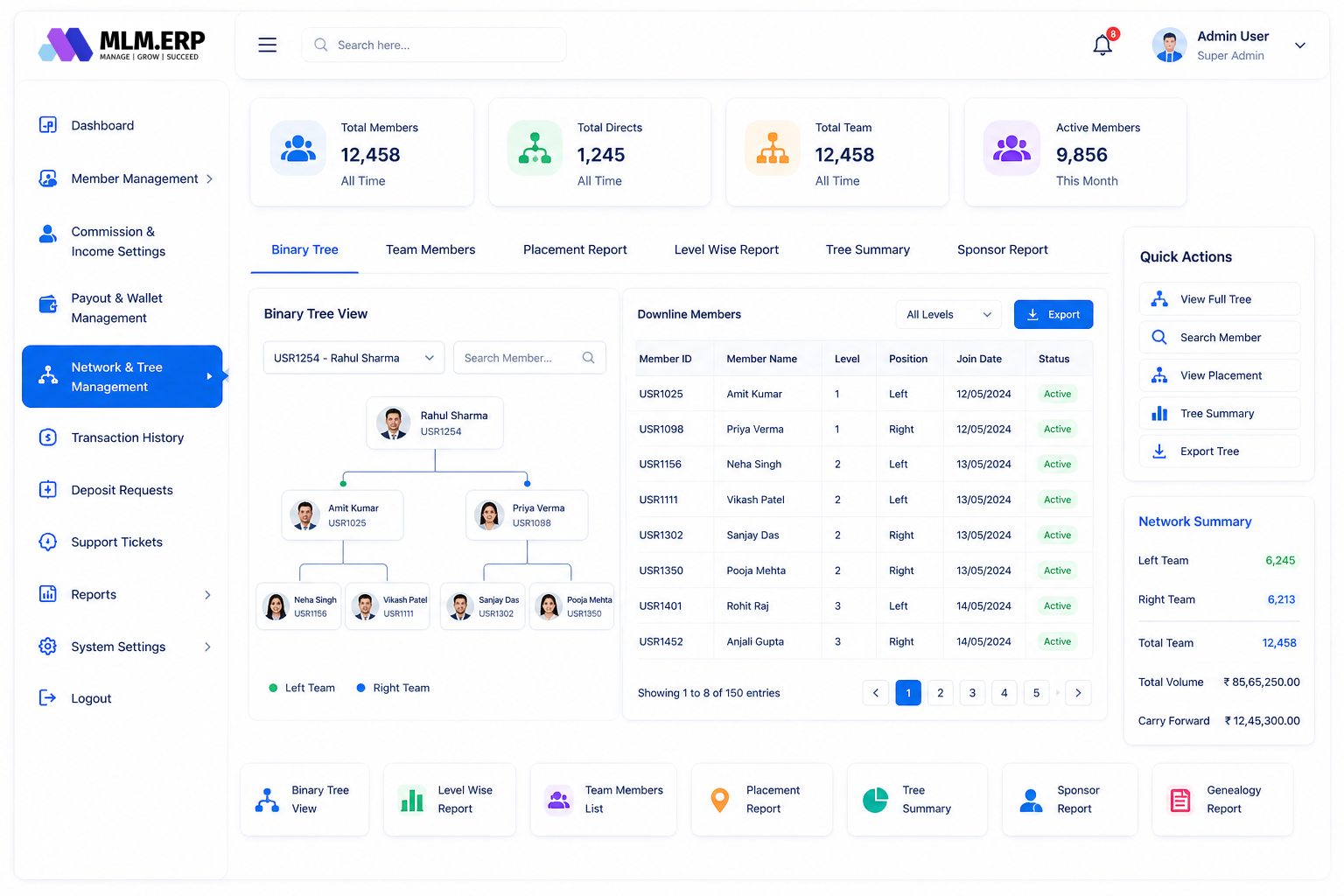
Configure income types, rates and levels, watch the network grow and approve payouts from the same dashboard. This is a real MLM.ERP screen.
Configure 2x2 up to wide matrices like 5x7 or 10x10, with depth limits enforced automatically.
Choose breadth-first, left-to-right or sponsor-tree placement so spillover is consistent and auditable.
Trigger a new matrix position automatically when a member’s matrix completes, if your plan uses recycling.
Members and admins see filled and empty slots level by level, with drill-down into each position.
Set a different commission rate for each level and change it later without touching code.
Notify members by SMS, email or WhatsApp when a slot fills or their matrix completes.
| Attribute | Matrix Plan | Board Plan | Binary Plan |
|---|---|---|---|
| Structure | Fixed width × depth grid | Small boards that split | Two legs: left and right |
| Payout basis | Level-wise volume in matrix | Board completion and exit | Matched (paired) leg volume |
| Main income | Level commission | Board exit bonus | Pairing bonus |
| Best for | Businesses that want a capped, predictable structure where spillover helps newer members fill their positions. | Companies running a simple product-linked cycling model that want transparent, rule-based board progression. | Product companies that want simple team-building rules and are ready to manage weaker-leg balancing carefully. |
See every plan side by side in the full comparison table.
Can't find your answer? Our team can review your plan design in a free demo.
Ask a questionIt means each member can sponsor up to 3 people on their first level and earn from 9 levels of depth. Anyone recruited beyond the first 3 is placed lower in the matrix. MLM.ERP lets you configure the width and depth from the admin panel and enforces the limits automatically during every placement.
Largely, yes. A forced matrix is one where width is strictly fixed, so extra recruits are forced into lower positions. Some companies add flexible rules such as sponsor-first placement. MLM.ERP supports both, so you can decide whether spillover follows breadth-first order or stays within the sponsor’s own downline.
When an upline recruits more people than their front line can hold, those recruits fill empty positions below, sometimes under newer members. That can help newer members earn level commissions before they recruit much themselves. The software records exactly where each person was placed and why, which supports transparency.
Yes. Hybrid plans are common, for example a matrix for joining packages and a unilevel bonus on monthly repurchases. MLM.ERP runs multiple income engines side by side, keeping each bonus type separate in the e-wallet and in reports so members and auditors can follow every credit.
Fill the board, exit at the top, split into new boards – every move tracked automatically.
Most popularTwo legs, one balanced team – pairing commissions calculated the moment volume lands.
SimpleA fixed percentage for every level below you – the easiest plan to explain and audit.
Tell us about your products, plan and markets. A product specialist will show you the admin panel, member back office and mobile app configured the way you work, then send a written proposal.