
Direct referral payout
A fixed share of each payment sent by the contract straight to the referrer’s wallet.
A decentralised MLM plan is a network marketing model where registration, upline relationships and commission payments are executed by smart contracts on a blockchain, so funds move directly between member wallets without a company-held balance. MLM.ERP builds decentralised MLM platforms in Solidity for BNB Smart Chain, Ethereum or Polygon, or on TRON, with a Web3 dashboard on top.
Web3-native projects that want transparent, verifiable rules and accept that deployed logic is hard to change.
Plan logic is written into a smart contract and deployed to the chosen blockchain.
Members connect a wallet, such as MetaMask or TronLink, and register with a referrer address.
When a member pays, the contract splits the amount and sends shares to upline wallets instantly.
All registrations and payouts are recorded on-chain and visible on a block explorer.
A Web3 dashboard reads contract data to show each member their tree and earnings.
Every income type below is configurable in MLM.ERP: rates, levels, caps and qualification rules.
A fixed share of each payment sent by the contract straight to the referrer’s wallet.
Shares sent to several upline wallets according to the level percentages coded in the contract.
Payouts when matrix slots fill, if the contract implements a matrix structure.
Payouts triggered when a member upgrades or recycles a slot, if designed in.
A member joins by paying 50 USDT on BNB Smart Chain. The contract sends 25 USDT (50%) to the referrer and 2.5 USDT (5%) to each of 10 upline levels in the same transaction. Each recipient sees the incoming transfer in their wallet within seconds of block confirmation, and anyone can verify the split by reading the transaction on the block explorer.
Illustrative figures only. Actual results depend on your plan configuration and genuine sales activity. No earnings are implied.
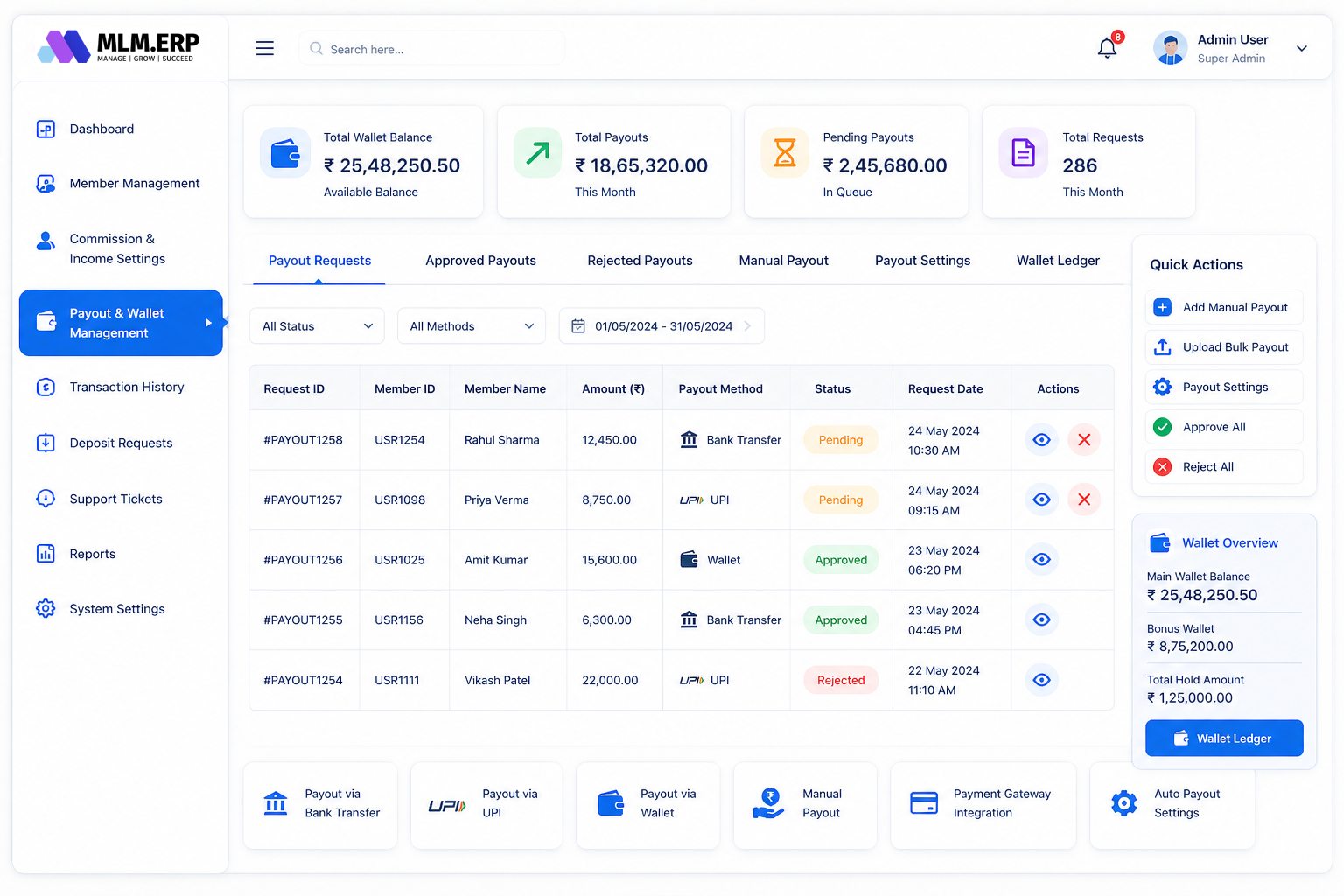
Configure income types, rates and levels, watch the network grow and approve payouts from the same dashboard. This is a real MLM.ERP screen.
Custom contracts for BNB Smart Chain, Ethereum, Polygon or TRON, written to your plan.
Members sign in with MetaMask, Trust Wallet, TronLink or WalletConnect, without passwords.
A Web3 dashboard reads contract events to render each member’s tree and history.
Verified source code on the block explorer lets anyone inspect the payout logic.
Tests, documentation and support for third-party smart-contract security audits.
Translate the dashboard so international members can use it in their own language.
| Attribute | Decentralized MLM Plan | Smart Contract MLM Plan | Semi-Decentralized MLM Plan |
|---|---|---|---|
| Structure | Smart-contract tree | Any plan, coded on-chain | Off-chain tree, on-chain funds |
| Payout basis | On-chain wallet transfers | Automatic contract execution | Server-calculated, chain-settled |
| Main income | Direct referral payout | Referral split | Any plan income |
| Best for | Web3-native projects that want transparent, verifiable rules and accept that deployed logic is hard to change. | Teams that need trustless, publicly verifiable payout logic and are prepared to invest in testing and audits. | Projects that want crypto-native payments but expect to adjust plan rules, add products or run complex reports. |
See every plan side by side in the full comparison table.
Can't find your answer? Our team can review your plan design in a free demo.
Ask a questionIt is an MLM plan whose rules run inside a smart contract. Members join with a crypto wallet, and the contract pays upline wallets directly when payments arrive. There is no company-held balance; everything is on the blockchain and publicly verifiable.
It depends on fees, speed and your audience. BNB Smart Chain and Polygon offer low fees and EVM compatibility, TRON is popular for USDT transfers, and Ethereum offers the largest ecosystem but higher gas costs. MLM.ERP can help you compare options for your plan.
Usually not easily. Some contracts use upgradeable proxy patterns or admin-controlled parameters, but these reduce decentralisation and add trust assumptions. Plan the logic carefully, test it on a testnet and have it audited before mainnet deployment.
Running on a blockchain does not exempt a scheme from law. If income depends mainly on new members paying in, regulators may treat it as a pyramid or unregistered investment scheme. Seek legal advice in your target markets before deploying any contract.
Your compensation plan as tested, verifiable code – deployed on the chain you choose.
HybridOn-chain payments with off-chain flexibility – change rules without redeploying contracts.
Web3Run any MLM plan with crypto deposits, payouts and wallets – on-chain where it matters.
Tell us about your products, plan and markets. A product specialist will show you the admin panel, member back office and mobile app configured the way you work, then send a written proposal.